Re:最好的新年礼物——58 岁,我被香港大学录取了Personal Statement
Applicant: Liu Kanxi (劉侃希)
Programme: MA in Chinese Historical Studies (Taught Programme), School of Chinese, The University of Hong Kong
I graduated in 1989 from China Textile University (now Donghua University) in Shanghai, and since 2001 I have built and managed my own garment import–export business. From a young age I have been drawn to Chinese culture, and in my daily life I have long kept two main aims: to run my company responsibly, and to deepen my engagement with Chinese culture. Over the years I have enrolled in classical studies programmes at Peking University’s Qianyan Guoxue (乾元國學) and the Houpu Chinese Medicine Institute (厚樸中醫堂) in Beijing. In 2015, while attending a traditional culture course at Fudan University, I first encountered Ling’s Shui Lang Quan(凌氏水浪拳). From the outset, I felt that this art was strikingly different and far from ordinary.
Later, I was fortunate to become a student of Grandmaster Ling Biao (凌彪), whose martial-arts name is Xiao Lixing (蕭力行), lineage-holder of Ling’s Shui Lang Quan (凌氏水浪拳) and founder of Ling’s Martial Arts (凌氏拳藝). Under his guidance, I have continued to practise and teach Shui Lang Quan – a branch of internal martial arts passed down in modern times from Mr Wu Yihui (吳翼翬), who served as Director of the Academic Affairs Office at the Central National Martial Arts Institute (中央國術館) in the 1930s. and was later passed down through the Ling family line. Through repeated practice, I have come to see traditional martial arts as a way to train the body while also cultivating balance, self-reflection, and moral character. Over the past decade, I have been running regular Shui Lang Quan classes in Nanjing, Suzhou and Hong Kong, and at the East China University of Political Science and Law.
For me, the saying “文以载道,武以证道” is a real thread running through Chinese culture. It means that literary work carries and gives expression to the Dao, while martial practice gives proof of the Dao. Reading establishes one’s zhi-yi (旨意)—the orientation of one’s ideals, moral stance and direction in life; practising martial arts tests one’s qi-gu (气骨)—the strength of one’s vital energy, integrity and inner backbone as they are expressed through the body’s movement. The deeper a person’s learning, the more their practice can move beyond external forms into a distinctive inner spirit and bearing. When a practitioner is deeply grounded in this cultural tradition, there is a real possibility that their martial art reaches a higher realm.
With this aspiration, I founded a non-profit in Hong Kong, Ling’s International Academy of Martial and Cultural Arts (凌氏拳藝國際文武學院), which I established under the motto “文武兼修,德健並養“- cultivating wen(文) and wu (武)together, and nourishing both moral character and physical health. I hope it can be a space where reading and practice continually inform and deepen one another. In recent years, we work closely with the Chinese Culture Exchange and Promotion Association and the Federation of HK Jiangsu Women Organisations to run cultural lectures and introductory classes in galleries, community venues, and school campuses. These experiences have made me feel more sharply how much I still need to strengthen my own foundation on the “wen” side, and how necessary it has become for me to seek more systematic training.
For this reason, I hope to set aside a period of time from my life to return to university and receive more systematic training. At fifty-seven, I am no longer at the usual age for a postgraduate student, yet my wish to learn is clearer than it was in my youth. I also take heart from figures such as Mr. Jin Yong(金庸), who in his eighties went to the University of Cambridge to study Tang history, showing that serious study can continue at any stage of life. Confucius taught that learning is a lifelong task: as long as one is alive, one should keep learning and keep putting what one has learned into practice, even in later years. Although I am past fifty, I believe that receiving systematic training in scholarly methods in a rigorous academic programme would be of great value for both my personal cultivation and my work in cultural transmission in the second half of my life.
The MA in Chinese Historical Studies (Taught Programme) at the School of Chinese, The University of Hong Kong (HKU), is especially attractive to me because of its emphasis on Chinese historiography and research methods. It also trains students in the close reading and organisation of historical materials within a cultural-historical perspective. In this programme, I hope to learn how to judge the reliability of different kinds of sources; how to sort and classify large bodies of material and draw out clear structures and lines of development; and how to master research methods and academic norms that I can use consistently in my future teaching and practice. I also hope to sharpen my sense of what constitutes a meaningful historical question and to develop sound academic judgement. HKU’s longstanding tradition of scholarship and open, interdisciplinary environment would provide an excellent setting for my aims, and would give me the chance to consolidate my years of practical experience into a more solid academic understanding of China’s intellectual tradition.
In the longer term, I hope that through my own teaching and writing, people who encounter internal martial arts will not picture a vague image, but a living Chinese cultural practice that they can learn and experience as a source of health and joy.
To “carry on the sages’ line of learning so that it will not be cut off” (為往聖繼絕學) has long been the aspiration of many Chinese scholars; I dare not place myself among them, but I hope that my work can move in the same direction. By applying to your programme now, I wish to make a small contribution to that aspiration—so that genuine Chinese culture can keep growing in today’s society, benefit more people in concrete ways, and remain alive from generation to generation.

 凌氏心意六合拳 → 凌氏心意六合拳-凌氏拳艺 → 心意六合拳论坛
→ 最好的新年礼物——58 岁,我被香港大学录取了
凌氏心意六合拳 → 凌氏心意六合拳-凌氏拳艺 → 心意六合拳论坛
→ 最好的新年礼物——58 岁,我被香港大学录取了


 发表时间:2026/3/7 11:59:40
 IP:
IP: <div>
<div>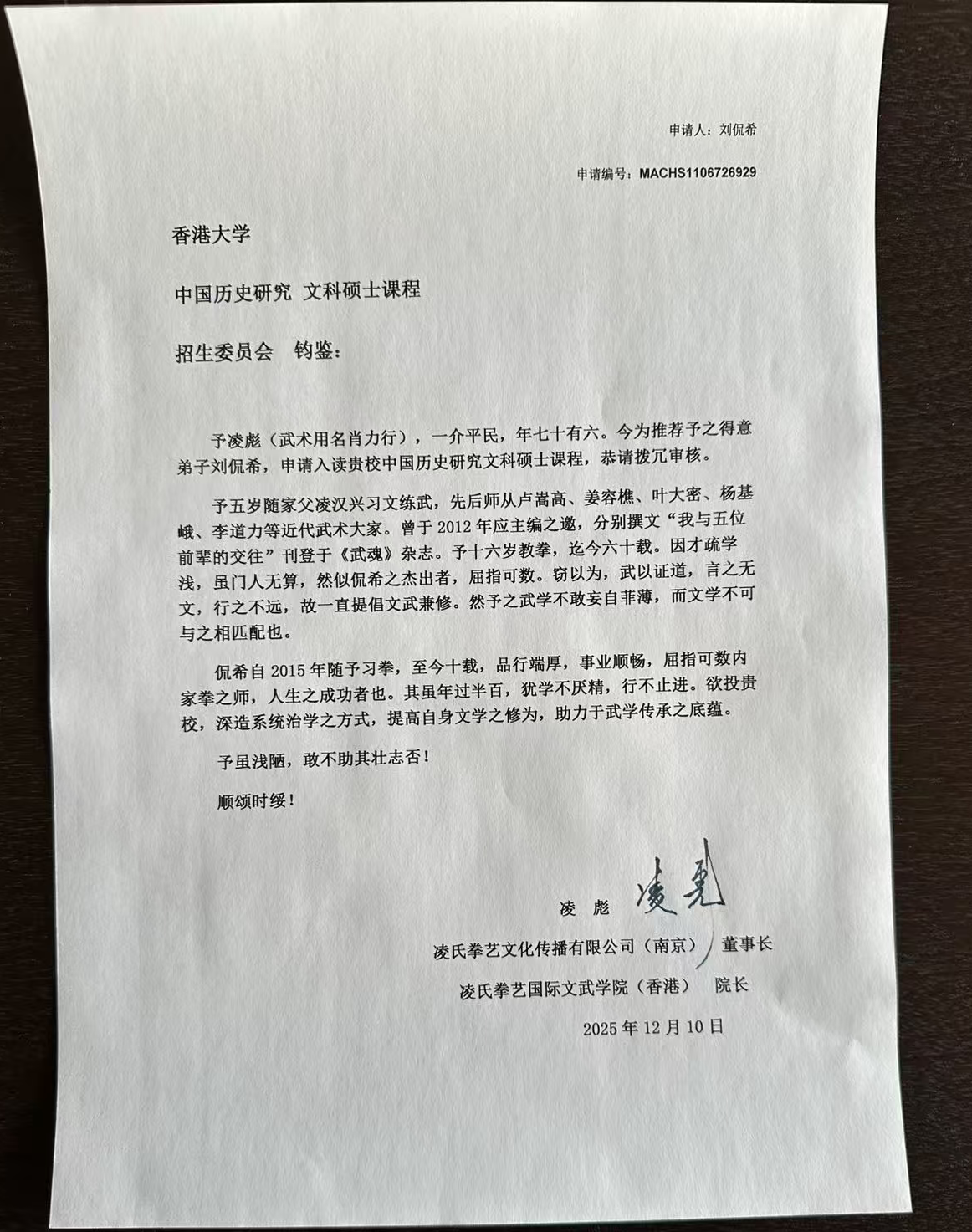 </div>